


know-how
17.06.2026
When the bearing protects itself – what sealed self-aligning roller bearings do
The system is running, everything seems stable, and then the bearing fails unexpectedly. No warning, no obvious reason. Yet the cause usually lies not in the load, but in something much more inconspicuous: dirt. Fine particles and moisture that have slowly worked their way into the bearing over weeks, breaking down the grease and corroding the raceways long before anyone noticed. Anyone who operates self-aligning roller bearings in conveyor systems, mines, rolling mills, or paper mills is familiar with this pattern. Sealed self-aligning roller bearings address this issue precisely: with integrated sealing discs that keep dirt out and grease in.

A simple idea with a big impact
The basic principle of a self-aligning roller bearing has been proven over decades. Two rows of spherical rollers on a hollow spherical outer ring raceway allow the bearing to align itself. Shaft deflection, misalignment, flexible foundations: the bearing compensates for all of this without generating harmful internal forces. It is a robust, resilient design that works even where other bearings quickly reach their limits.
The sealed version enhances this design with two integrated sealing washers, one on each side. The result: The bearing is pre-lubricated and protected right from the factory and is ready for immediate use. In practice, this means less wear, longer service life, and, in many cases, significantly reduced maintenance intervals.
Low-maintenance, but not maintenance-free
However, it’s worth taking a closer look here. “Sealed” does not automatically mean “maintenance-free.” Most designs feature a circumferential groove and lubrication holes in the outer ring, as relubrication may well be necessary depending on operating conditions. At high temperatures, high speeds, or in particularly harsh environments, relubrication is unavoidable.
When relubricating, do it right: slowly, with light pressure, while the bearing is rotating, until fresh grease oozes out from the seal lips. Too much pressure damages the seal—and thus the very protection you’re trying to maintain. Those who wish to do away with lubrication holes entirely can request a closed outer ring from some manufacturers. One factor that is often underestimated is always crucial here: the interaction between the seal and the grease.
The seal and grease must be compatible
The temperature resistance of a sealed bearing depends not only on the seal material, but always on the combination with the grease used.
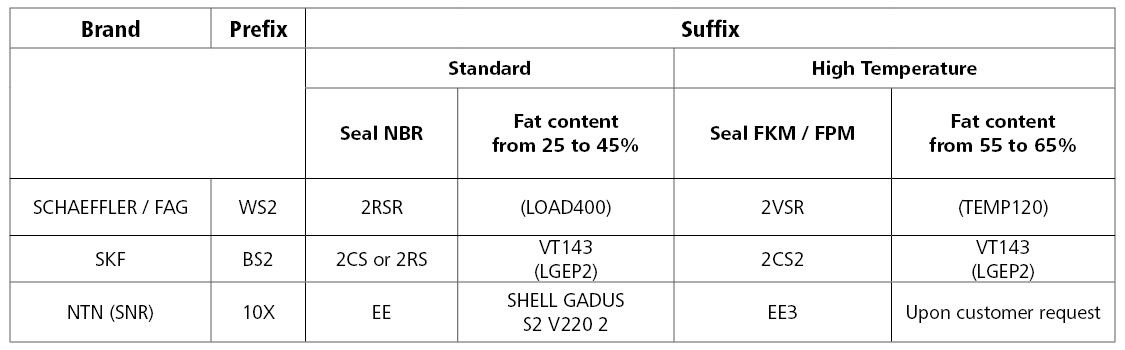
NBR is the standard material and, depending on the manufacturer and grease, can withstand temperatures up to approximately +100 °C. Short-term exceedances are possible; however, for continuously higher temperatures, other materials such as FKM/FPM are recommended, as they allow operating temperatures of up to +180 °C. Since manufacturers use different specifications in this regard, the exact limits should always be verified for the specific application.
The same applies to lubricating grease: the selection depends on temperature, load, and speed. SKF supplies its products with LGEP2 as standard, Schaeffler with Arcanol LOAD400 or TEMP120 depending on requirements, and NTN-SNR with a 30% grease fill for high loads. And speed is precisely the key limiting factor that should not be underestimated.
Where Sealed Bearings Reach Their Limits
Not every application is suitable for sealed self-aligning roller bearings. The most important limiting factor is speed. Sealing lips generate friction, friction generates heat, and at high speeds, things simply get too hot. Open bearings with a separate sealing system are therefore often the better choice for high-speed applications. The specific limit in each case depends on the type of seal, the grease, the bearing load, and the operating temperature.
One thing that isn’t lost in the process is the self-aligning capability. Even in the sealed version, self-aligning roller bearings compensate for misalignment. Depending on the manufacturer and model, angular adjustment ranges of up to 0.5 degrees are specified. And when it comes to design versatility, there are more possibilities than many people realize.
More options than many expect
The seal design always depends on the manufacturer. Depending on the manufacturer, different options are available for the cage, bearing clearance, and outer ring. If you do not need lubrication holes, you can choose a closed outer ring. If you have specific requirements for bearing clearance, you can choose from C2, C3, and C4 in addition to the standard CN class. Dimensions are generally based on ISO 15, although the width may increase slightly due to the sealing washers. For tapered designs, the following also applies: During installation, it is recommended to use a clamping sleeve to avoid damaging the sealing washers.
Schaeffler, for example, illustrates just how extensive this variety is: depending on the bearing size, four different sealing concepts are used. For outer diameters up to 160 mm, a press-fit steel-elastomer seal is used. From 160 to 320 mm, the seal snaps into a groove in the outer ring and locks in place. For diameters of 320 mm and above, there are two additional variants: one with a retaining ring and one with a bolted steel plate and elastomer sealing lip for particularly demanding conditions. However, all these options require that the bearing be installed with care.
What to keep in mind during installation
Sealed bearings areless forgiving during installation than open designs. If the bearing is pressed in at an angle, there is a risk that the seal will come into contact with the cage or rollers and become damaged before the machine even runs for the first time. When pressing in the bearing, using a tension sleeve can help protect the sealing washers from damage. When heating, a clear upper limit of 80 °C applies, unless the seal and grease are proven to withstand higher temperatures. A seal that is already damaged during installation no longer provides protection. This may sound obvious, but it is frequently underestimated in practice.
Where these bearings are used
Sealed spherical roller bearings really shine wherever dirt is a daily occurrence, maintenance options are limited, and downtime is costly: in conveyor systems, mining and quarrying operations, steel and metallurgical plants, continuous casting facilities, paper and textile mills, elevator systems, industrial gearboxes, material handling facilities, the food industry, and power generation. What these sectors have in common: A bearing that lasts longer and requires less attention is not just a nice extra there, but a real economic advantage.
Conclusion: Small adjustment, big impact
Sealed self-aligning roller bearings don’t solve a new problem, but a very common one. They provide protection precisely where conventional bearings often reach their limits: in contaminated environments. Whether they are the right choice always depends on the specific application. Temperature, speed, lubrication, sealing material, and installation conditions must all be compatible. When these factors are properly balanced, the result is a solution that works reliably and requires significantly less attention in everyday use.


